Featured

Fires in the Cane Fields, Fires in the Cities

In 1791 slave owners in Le Cap, Saint Domingue, saw a wall of fire consuming the island’s sugar cane fields. Black revolutionaries set the fields aflame, destroyed the plantations on which they had been tortured and killed their torturers. Cities would change hands over and over again in the course of the wars that followed this first insurrection. The revolutionaries never left a city standing for the French to occupy. They burned the fields behind them. If the black army could not hold the cities the whites would not be allowed to have them. If they could not work the fields as liberated people they would ensure there were no fields they could be made to work as slaves. “‘Why do you burn everything?’ asked a French officer of a prisoner. ‘We have a right to burn what we cultivate because a man has a right to dispose of his own labor,’ was the reply of this unknown anarchist” (James in Black Jacobins, 361). Black labor created Saint Domingue. Black labor burned it to the ground. Flames burned Saint Domingue. Flames gave birth to Haiti.

It is hard not to see the similarities in the flames that burned Saint Domingue and the flames that burned Ferguson1, a link between past and present. The ghosts of the Haitian masses, the peasant masses everywhere, are with us in them. Riots provoke varied responses; many condemn them, some support the sentiment but criticize the tactic, some revel in the mayhem and seething potential, and some simply let out a long-held breath and accept a measure of catharsis. In the popular imagination, though, riots can never rise above the level of “necessary” or maybe “just”. A riot is messy. For every photo of a cop car in flames there’s a photo of people stealing luxury goods—and that can make it hard for even people who support the feelings that animate riots to really support the rioters. Maybe that is because we do not actually understand what a riot is. We do not understand the real politics of a riot.

What the fire said in Saint Domingue two centuries ago is not what says today, at least not precisely. Things are muddier. We are deeply connected by a web of social production and Labor, and the issue of how much we are each implicated in a network of exploitation does not allow for as easy a demarcation of lines as the slave-owner dynamic did once. Riots demonstrate a deep understanding of this interconnectedness. More to the point, they point out that the everyday experience is a denial of this interconnectedness.

Rioters are invariably condemned for destroying their own communities. But the very authorities who condemn rioters routinely deny the rioters ownership of their own communities. Policing and gentrification, for instance, create barriers to access that prevent common ownership of the commons. A sense of ownership is hard to foster when under constant threat of violence and dispossession and the constant discipline that police bring to any neighborhood. Gentrification alienates us from any identification we have with our neighborhood by appropriating the neighborhood’s character while casting out the actual characters who live there.2 We are reminded that we are basically living in an alien space; our homes are owned by someone else, the stores where we shop can easily be made unavailable to us and replaced with boutiques we cannot afford and where we do not belong, the community spaces we enjoy are “beautified” and are no longer ours—all this enforced, of course, by police. All this activity points at a deeper refusal to acknowledge the social nature of production and the fact that everything in the social world is jointly produced. It denies that the commons belong to us commonly, shuts us out of the social world, and ransoms our share of the wealth produced by a society that could not exist without us. Joshua Clover writes that riots are ultimately about distribution, about the control of the movement of people and goods. That claim needs to be made more specific. Riots are about ownership of the commons and of social wealth. The claims rioters make are about distribution, yes, but ultimately point past questions of distribution and invite us to think about justice differently. Riots fundamentally stake two claims: first, the rioters own the commons (that the commons are indeed common and not the possession of the governing class3) and second, everyone should take whatever they like from the wealth that we all produce.

Ownership means many things in legal and philosophical senses, but we are not interested in these definitions. Ownership is interesting to us in so far as it tells us something about our presence in the world, what we can do and what can be done to us. That is, ownership is a useful concept because it does and says something about action. We seek not to justify ownership but to understand it in practice. Approached in this way, ownership means the ability to use or to destroy. You own something when you can dispose of it, as the nameless revolutionary Haitian told his French captor. Mechanisms of control, like the law and the police, are set up to enforce these abilities on the behalf of some to the exclusion of everyone else. The world’s default state is such that everything is held in common. Ownership steals from the commons. One example of this: a vacant lot owned by the state or by a member of the rentier class cannot be used by the community. It can neither be improved on nor vandalized. Guerrilla gardening projects are routinely destroyed by the state and vandals have state violence visited on them. Alternatively, the state can plant non-productive species on so-called public property or can demolish natural beauty for the interests of the ruling class, that collection of owners and managers who have gotten together to control social wealth to their own benefit. The state owns that plot of land not because their monopoly on violence allows them to create and destroy at will and prevent anyone else doing the same. This understanding already shows us two ways to dismantle private control and return that lot to the commons, and to reclaim the commons in general. One would be to prevent private authority (which includes the state) from destroying and thereby assert our ability to create or preserve, as native land protectors and their allies have done so courageously both in recent years and over the long centuries. The other would be to destroy what private authority claims ownership over, showing in spectacular fashion that private authority cannot preserve what it has stolen. Such destruction shows who owns the social world in practice—the riotous community4.

Riots contest ownership directly and acts out in spectacular fashion what ownership does. There are no fancy arguments, no demands for laws to change. Riots say: you say you own this, but if you do why can’t you stop us from destroying it? Every burned out cop car and every smashed window are claims of ownership that rioters make on the commons. When pushed far enough, as seems to be happening in France, riots create such an instability in the established mechanisms of control of space that revolutionary space opens up. It is in this space that new claims of ownership based in creation can start to be made. Riots are fundamentally about space and claims to space. This is the larger question lurking behind whatever immediate gains a riot can win. It seems increasingly clear to me that revolution will look more like a collapse than an overthrow5. Revolution happens when the space occupied by the state becomes unstable. This can result from many things, but broadly occurs because of a confrontation or a collapse. Intensifying numbers of pocket collapses in state power, whether due to natural or economic disaster, certainly point in that direction. We can either wait for collapsed space, brought on by any one of the impending crises, or we can create collapsed space. I say we should create collapsed space by destabilizing the social world6, a social disaster that carries in it a new understanding of sociality, rather than waiting for the final crisis and risking that we miss seeing it or that it happens too slowly to be fully recognized.7 Riots represent the first step, destabilizing ruling class control of the commons, and point the way to a new kind of space that is radically communal. This is what Joshua Clover points to when he argues that the commune is the form dictated by the riot; that is, the commune form of organization is contained within and emerges from the riot form of struggle (Clover in Riot. Strike. Riot). What precisely the commune form of organization looks like should be hotly contested but will not be discussed here.

Burned-out cop cars and broken windows are not the only images which emerge from a riot. Looters, especially when photographed carrying away PlayStations or TVs, are used as a bludgeon to condemn and trivialize rioters. But the rage manifested in riotous destruction and the desire manifested in looting are not separate. Looting makes its own complementary claim by stealing back a rightful share of the pile of wealth that is produced in fundamentally social ways.

Social wealth refers to something like Elizabeth Anderson’s cooperative economy view: people regard every product of the economy as jointly produced by everyone working together. … the attempt, independent of moral principles, to credit specific bits of output to specific bits of input by specific individuals represents an arbitrary cut in the causal web that in fact makes everyone’s productive contribution dependent on what everyone else is doing. Each workers capacity to labor depends on a vast array of inputs produced by other people—food, schooling, parenting and the like. It even depends on workers in the recreation and entertainment industries, since enjoyment of leisure activities helps restore energy and enthusiasm for work” (321, “What is the Point of Equality?”).

This causal web illustrated by Anderson is impossible to untangle. Every output in our society has multiple inputs many of which can be taken, either alone or in some combination, to be sufficient to create that output. However, there are no definitely determining inputs. We cannot actually remove any of them, and there is no way to know what would happen if we did. Rather than construct narratives around incomplete explanations, we should consider all output a product of all input—in other words, as inherently social and common. We cannot really imagine one kind of production without the interlacing web of social activity that makes that production possible.8 We are in a condition of over-determination that makes the question of distributive justice unanswerable. This produces a situation not of post-scarcity but of post-distribution—there is no technically just metric by which to determine what distribution ought to look like. Recognizing this situation means recognizing that price-markets are facades that only serve to justify the ransoming of social wealth by those with power. Wealth produced by all is hoarded by the governing class and withheld for a price. The looter makes an affirmative claim to our share of social wealth, a claim not informed by personal need any more than our social production is informed by social need. Looting is a form of collective price setting by which all prices are returned to zero (Clover in Riot. Strike. Riot). The looter makes a mockery of price in a rebellion against distribution.

This inter-connectedness and the contradictions it creates heightens as capitalism devours itself. As late capitalism develops every activity is converted into Labor. Neo-liberal economy, as it marketizes everything (even and especially the self and the production of the social world), causes this conversion. “If more and more things are looked at as commodity, we have to start looking at labor, means, and product differently” (Peter Coffin in EVERYTHING IS LABOR). Social media, for instance, increasingly dominates how we consume social interaction. On social media we are simultaneously the product, the producer, and the means of production. This is increasingly the case for the entire social world. Hannah Arendt defines Labor as the necessary activity we undertake to reproduce life. Labor is the precondition for the social world but leaves nothing behind in it (Arendt in The Human Condition, 80-92). Arendt argued that the world is being converted into a world of laborers, each only concerned with reproducing their personal world. “None of the higher capacities of man was any longer necessary to connect individual life with the life of the species; individual life became part of the life process, and to labor, to ensure the continuity of one’s own life and the life of his family, was all that was needed” (Arendt in HC, 321). Arendt refers to the resulting society as a society of jobholders. What Arendt could not have predicted was the commodification (rather than the elimination) of all our “higher functions.” All our experiences, all our actions in the world, are that of Labor. Arendt’s theory suggests that as Labor expands, the social world would deaden and empty because all our activity would be going to reproduce the social world but not to make it into anything or to do anything in it. When all activity is Labor, all activity is a contributing factor to creating the world. And yet we are alienated from our social wealth and denied a share in it, thus the deadness of the social world. We understand that without us the social world could not exist, yet everywhere we are confronted with it as the private property of someone else. We are asked to buy back our existence in the social world.

The expansion of Labor predicted by Arendt, and clearly manifested under neo-liberal economy, combined with the alienation of laborer from labor-power originally observed by Marx is a more profoundly total alienation than either of those authors originally imagined. Alienation from our Labor understood as alienation from every possible way of acting on the world stage, is deeper than the alienation of labor-power talked about by Marx or the world-alienation talked about by Arendt.9 It reaches beyond even the product of our labor in the proper Marxist sense; our share in the social world, social existence itself, has itself been stolen from us.10 By stealing back their share of social wealth, looters mock the idea of buying back our social existence. Rioters defy our on-going exclusion from the commons. When we riot and loot we aim at nothing less than a rude re-expropriation of the social world itself.

Contact the author at noaheatstherich@riseup.net

1 Or Detroit or Oakland or any other American city where riots have swept through in the past decades.

2 I am reminded of a conversation I had with Chuck, a homeless man in a neighborhood near mine. Chuck told me he there was a time he could call anyone to get what he needed. Now, he said, he can’t even get a burger without begging. Chuck is confronted every day with a neighborhood where everything is the same but everything has changed. His neighborhood has been turned into an alien landscape where he is not welcome.

3 Controlled and administrated on behalf of the ruling class by so-called representatives, whose function is not to represent the interests of the people they represent but usurp their desires, discipline them and bring them into line.

4 It is important to understand that what is being asserted in these to actions is not a public ownership commonly understood but a commons that belongs to no one and everyone simultaneously, which has a resting state not of so-called nature or of un-use but of communality and common use defined as loosely as possible.

5 This idea is not original to me, but comes from a passing comment in an article I can no longer find.

6Such as it exists for us, in limited and alienating ways.

7 This is not to be understood as an accelerationist position. The hegemonic space that exists now is made unstable simply by our acting in it, either as actors who are meant to be subjects only and never actors or as actors whose agency is only recognized within prescribed roles. We are in a play on a stage and breaking the fourth wall is enough to make that space unstable, no special manipulation of material conditions required.

8 Even so called bullshit jobs (as defined by David Graeber) are inexorably tied up in our current social production. This is not to say that bullshit jobs are necessary full stop. The mode of production is changeable. The fundamental sociality of that production is not. Recognizing this sociality is the fundamental characteristic of post-distribution.

9 World alienation is, literally, the alienation of human beings from the world that surrounds them. It is the process by which we are removed from the world through expropriation (kidnapping) and confronted with the world through appropriation (ransom) (Arendt in HC, 248-254). Labor-power alienation is the process by which the laborer is confronted with the product of her labor as a commodity, and experiences this alienation as a self-alienation; capital, or privately owned property, is alienated life (from The Marx-Engels Reader).

10 It is for this reason that working class cultures are either marginalized and criminalized or appropriated. Nothing is more alienating than seeing your culture donned as a costume, at the same time as you are castigated for producing culture that does not reproduce hegemonic norms. The basic point is this: Every action we could take in the social world, every way of existing in the social world, leaves us in an alienated position. If we turn away from the social world in an attempt to create our own, we cease to exist; we become invisible at best and an alien walking among Earthlings (the alien embodied) at worst, with often brutal consequences.
Building a Battering Ram: Incomplete Thoughts on Destroying Whiteness

The following was prepared by me for a potential discussion on what white people can do about whiteness. The discussion has been indefinitely postponed, but my frustration with the inadequacy of white discussions about whiteness has not abated. I am frustrated with white examinations of the topic, the way they (we) “refuse to see how white culture is rooted firmly in capitalism and imperialism; refusing to reject it beyond superficial cultural appropriations” (Lorenzo Kom’boa Ervin, 1996). “The only way to fully work through this hang up is to gain even a small percent of the courage of a black adolescent and overcome their white guilt with a fist, a stone, and a Molotov cocktail” (We Still Outside Collective, 2020). This piece is my suggestion for how we might break out of our paralysis and finally do so.

WHAT IS WHITENESS

Whiteness is the set of hegemonic identifiers and cultural norms associated with the capitalistic expression of colonialism and imperialism. Hegemony defines not just the dominant traits expressed in a culture but the ways in which norms are created and manipulated. It is the lens through which a culture is expressed and made real, or reified. Cultural hegemony occurs when socially dominating structures have control over educational mechanisms in a society. Domination is possible without hegemony, but hegemony is not possible without domination. Hegemony secures domination. Hegemonic identifiers shift to keep the ruling systems in place and incorporate or eject groups and behaviors as necessary. The dominant system in the United States is capitalist colonialism, where colonialism is understood to be the primary expression of domination, and capitalism its latest expression.

Colonialism and imperialism are systems which create divisions between the core and the periphery. Traditionally, these relationships look like nation-state and colony or settlement and frontier. The capitalist version of these systems places Capital at the core and land and people at the periphery. In economics, capital, labor and land are understood to be the three factors of production. Capital is generally understood to be the product of land and labor. Under capitalism, however, Capital alone has agency; land and people do not. Globalization has expanded the influence of systems which place Capital in the core position. Since corporations span the globe, the frontiers of imperialism are no longer defined by nation-states but by the movement of Capital and its activity, which is the capitalization of land and people(s). Membership in whiteness is generally earned by support for and enforcement of capitalization, including capitalization of one’s own identity, value, and existence. Irish people, for example, earned their admission to full whiteness in the US by becoming policemen, defending Capital and beating other racialized groups. Whiteness is an identity which is entirely capitalized and which seeks to enforce capitalization against others. In everyday language we often associate whiteness and acting white with acting on behalf of Capital (demanding to see a manager, for instance), the commodification of cultures and identities, or engaging in capital-intensive activity (like an artists’ retreat or destination wedding). It was produced by capitalist colonialism, and reproduces those systems in turn.

Whiteness is a fundamentally political category characterized by a shared relationship to the imperial core rather than a shared cultural heritage. The Proud Boys have taken this to its logical conclusion, defining their White supremacist gang as western chauvinist, a clever substitution for whiteness which has all the same signifiers and an expanded appeal. This characterization of whiteness comes from the Haitian revolutionary Dessalines in 1804. Given that the Haitian revolution loomed like a spectre over the early United States, it is important to study these definitions for the influence they may have had on the formation of whiteness and blackness in the US. The 1804 constitution defined all Haitians as black, regardless of skin color, where blackness was defined by resistance to imperialism. Whiteness was thus de facto defined by support for imperialism. These definitions collapsed dozens of racial classifications which were in use in French-controlled Saint Domingue, and continue to inform our political conceptions of racialization.

WHAT IS CAPITALIZATION

Capitalization is the activity of Capital. In order for capitalism to be properly understood, Capital has to be conceived of as having agency under capitalism. Under capitalism, Capital is transformed from the product of labor and land into a valorized subject with its own subjectivity (the distinction Capital and capital). People and land are objects which Capital acts upon, and act as subjects only to the extent that they are identified with Capital. Capital has drives and activity; in the main, it seeks to turn everything else (land and people, and the social products thereof) into itself. This transformation is capitalization–the changing of land and people into resources and slaves or raw materials and workers. Think of Capital like a ravening machine which devours land and people and spits out copies of itself–capitalized versions of the people and land it consumes. In this way the core constantly consumes the periphery and creates new peripheries to consume in turn. This drive creates a contradiction, since Capital can never be finished consuming land and people, and must constantly create new frontiers–not everyone can be inside the core, but the core must constantly consume, and boundaries–which also bound whiteness–are therefore always shifting. This activity is violent and involves the theft of land and people and the creation of systems which threaten people with starvation, jail, and physical violence. Support for and enforcement of capitalization–which is the material basis for membership in whiteness–is violent both currently and historically, both actually and potentially.

HOW WHITE WORKERS HAVE HISTORICALLY EXPRESSED WHITENESS

The history of white participation in the struggle against capitalism is one of betrayals–of women by men, of white immigrant workers by White workers, and especially of black and indigenous (BIPOC) workers by white workers. The historical process by which modern whiteness was constructed goes like this: proletarianized white workers identify with Capital and enforce capitalization against land and people in exchange for admission into whiteness. As new groups gain admission, whiteness gradually changes form without ever losing its primary characteristics of being hegemonic and completely capitalized. This obviously paints with a broad brush, but it is important to understand that the legacy left to us by our collective ancestors is one of violence against land and people in the name of Capital. Examples include the witch hunts in early capitalist societies (both in Europe and the so-called New World), Black Codes in 1650, the Homestead act and pioneering in general, the exclusion of Irish, Italian and other immigrant labor from the budding labor movement, the exclusion of Black and Latinx labor from the labor movement in the 1800s by those self-same immigrants, the disenfranchisement of free black people with the support of working class whites, the Draft Riots and antipathy to ablation displayed by the Irish in the middle 19th century, the class collaboration exhibited by white workers after the New Deal and into the present day, and so on. There are also profound instances of solidarity, as in the Battle of Blair Mountain, but the overwhelming pattern of white working class organization is the prioritization of winning racial privileges over engaging in class struggle. Thus, the greatest contribution white workers can make to revolutionary struggle, indeed the one contribution they must make, is the destruction of whiteness from the inside.

DEVELOPING A METHODOLOGY FOR DESTROYING WHITENESS

As white people, or as people who think we’re white to borrow Baldwin’s phrase, we are uniquely positioned to attack whiteness from the inside. This is a material project, not an ideological one. The goal here is to use our positionality inside whiteness to destroy it. The first step to this is immanent critique, which will allow us to identify the weaknesses in whiteness, its vulnerabilities, and the second part is to use those insights to turn our privilege against itself and in the process pull whiteness in on itself like Samson collapsing the temple. This is a project of self-destruction and self-reclamation, since in destroying our capitalized identity we help create the material conditions for our own self-realization. We are not attempting to remove ourselves from whiteness. As long as the system that produces whiteness continues to exist, we cannot meaningfully escape whiteness. In order to escape whiteness we first have to tear down the system that produces it. This is not a project of freeing our minds from the bonds of whiteness and settler-colonialism. This is a project which requires radical, antagonistic action. Our analysis should compel us to act, and if it does not then something has gone seriously wrong. This is also different than using your privilege to aid others. Using privilege to protect, amplify, or otherwise help others can be good and useful, but it still preserves privilege itself. When a white woman in Portland does nude yoga to deescalate a police response, she is using the power of white womanhood to protect others but without challenging the logic of that power and the systems that produce it. We are trying to build and use a battering ram, not an umbrella.

IMMANENT CRITIQUE & DECONSTRUCTION

Immanent critique is a category of critique which derives the standards it employs from the object criticized rather than approaching it with independently (externally) justified standards. In the main, this means looking into the conditions of possibility of argument being made or the object being criticized. Deconstruction, according to Derrida, tells us that the logic of a text contains within itself the antithesis of that logic. Combining the two methods, we can see that understanding and critiquing whiteness will reveal logics we can use to dismantle it. We will first use immanent critique to reveal the systems that produce whiteness and dissect its logic, then use deconstruction to discover a new logic we can use to take action and destroy whiteness.

We want to do immanent critique on our own experiences. Our experiences of whiteness are produced by a system which we must critique in order to dismantle. Our experiences of whiteness represent our interactions with that system, and by examining them we can discover the logic by which the system operates and reproduces itself. Those insights are the jumping off point for the critiques we need to make in order to identify the structural weak points of whiteness. Immanent critique and deconstruction are tools that allow us to dissect our experiences with an eye to discovering whiteness’s systemic roots. By critically examining our own experiences, we can discover and dismantle the systems that produce them.

This dissection is what whiteness workshops and white carcasses fail to do. These spaces have plenty of room for individual expression, confession, flagellation and even pathologization (always individualized, of course), but little room for methodical examination and destruction. Acknowledging and examining whiteness in our own lives is only the beginning. If we stop there we fail to make whiteness our problem, and we cannot begin to understand what liberation means.

“Of This Planet! For This Planet!”

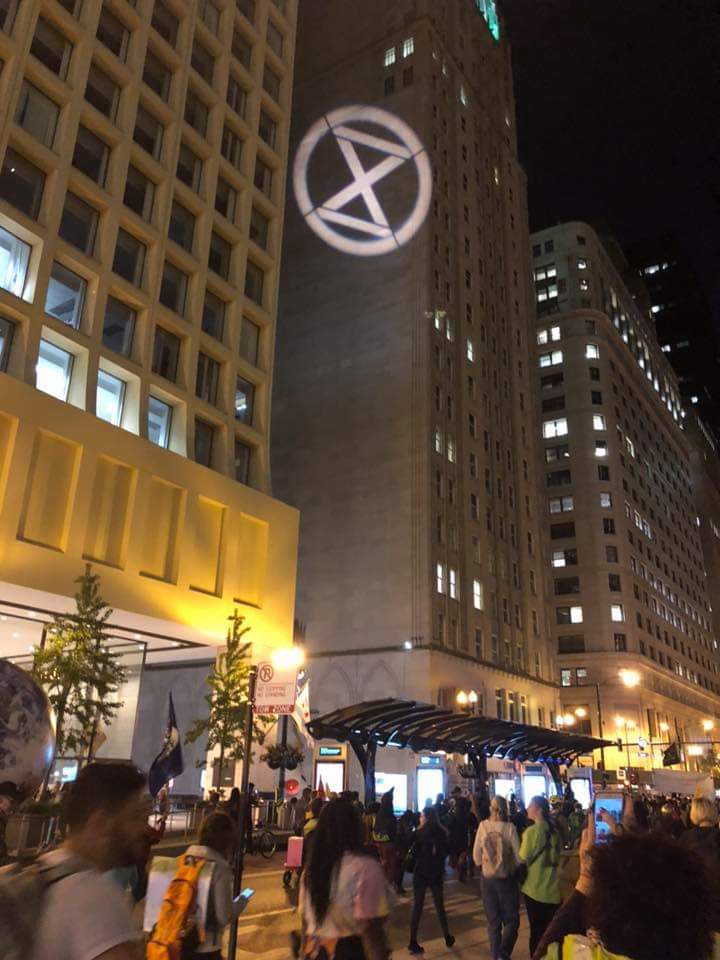
On Monday, October 7th, Extinction Rebellion took over the intersection outside Chicago City Hall. A blockade turned into a celebratory march that wandered the Chicago streets for two hours, forcing back cars and making a mess of downtown Chicago traffic by occupying and then abandoning busy intersections. Decisions emerged organically, and the march moved with its own life. Over their scanner, police described the march as moving like a chicken with its head cut off. The marchers thwarted police blockades twice.

In one intersection, a chant I’d not heard before broke out — “of this planet! for this planet!” The chant stuck in my head. We are of this planet, acting for this planet. It reminded me of an idea from Rousseau, that if we could communicate with the animals and the plants we would be obligated to invite them to the assembly. This planet speaks louder every day. Every scientific finding, every new disaster, tells us something about the state of our social relationship with the ecosystem in which we live. As Rousseau observed some 300 years ago, and as that chant reminds us now, democracy demands that we listen.

Extinction Rebellion has set itself strong democratic commitments. The third demand reads, in part, “we demand a Citizens’ Assembly to oversee the changes, as we rise from the wreckage, creating a democracy fit for purpose.” The UK, where the demand originated, has previously created such assemblies. In the United States, where there exists neither a tradition of such practices nor a mechanism for their creation, what this demand could mean in practice has been very much up in the air. In Chicago, the demand has been modified. “People’s Assemblies” has replaced “Citizen’s Assembly”, and one version reads, “that the government must create and be led by the decisions of a people’s assembly on climate and ecological justice.”

This kind of democratic commitment must be accompanied by a commitment to express the general will. This is not a matter of any particular procedure. The general will consists in the identification of the social self and that self’s expression. In the case of our social relationship with other species and ecosystems, this means identifying the part of our self that is of this planet and expressing that self together with others. This practice has been honed by black and indigenous communities.

Ecological struggle on the frontlines starts at the intersection between peoples’ social lives and the ecosystems in which they live. Learning from this approach is central to being of this planet and for this planet. Extinction Rebellion has instead fetishized “hard truth” and sacrifice, presuming that a focus on social justice shows a refusal to deal with the scientific reality of climate change. This preserves a colonial outlook toward vulnerable communities and puts any expression of the general will out of reach. The specter of eco-fascism lurks in the failure of our democratic commitments.

What I saw on October 7th was a genuinely democratic practice, and I believe many in Extinction Rebellion, myself included, are committed to radically expanding that practice. But I also see in Extinction Rebellion the dangerous side of the Western environmental movement. I see members hold tight to climate science without understanding the climate emergency’s social dimension. This limits rather than expands our democratic practice. If we fail to understand how the climate crisis is a social crisis, eco-fascism will grow in our midst and choke our movement.

It’s Time for a People’s Court

Draconian legislative attacks on abortion access require a renewed defense of women’s and trans men’s bodily autonomy. The Supreme Court cannot be relied on to provide this defense. Historically, the court has been a bastion of reaction. The American Left should hear the call to defend Roe v. Wade and come back with a more radical demand: abolish the Supreme Court.

Justice Clarence Thomas, writing for the conservative majority in the Supreme Court decision overturning the court’s commitment to precedent set by previous Supreme Court majorities, wrote that “stare decisis is not an inexorable command and we have held that it is at its weakest when we interpret the Constitution.” A majority may rule as it likes; the until-now-sacred adherence to precedent is a matter of convenience. Justice Stephen Breyer, writing for the minority on the court, wrote that “today’s decision can only cause one to wonder which cases the court will overrule next.” The majority’s new prerogative to ignore stare decisis poses a renewed roadblock for all progressive efforts and threatens to strip women and trans men of bodily autonomy. We must entrust defense and advancement of rights to popular power, not to a historically conservative institution.

The Supreme Court is undemocratic and reactionary in its history and design. The court has a long record of taking decades to swing towards social justice, meanwhile handing down decisions that make real progress difficult. Landmark shifts in civil rights are marked by Supreme Court cases not because the court reliably decides in favor of protecting and extending social rights but because it is often the last thing in the way after public opinion and even legislators have climbed aboard the engine of social change driven by mass movements. At best, the court is ineffective, unable to enforce Brown v. Board or stop the horrific Indian Removal Act. Most often, it is a bastion of reaction, stymying efforts to build a more just world. Recent — and, given the court’s history, relatively mild — examples: the court gutted the voting rights act, which led to renewed voter repression in the black belt; removed the ACA’s mandate, effectively hobbling any chance that legislation had at lowering insurance premiums; took the brakes off bourgeois political spending with the Citizens United decision; crippled public sector unions in the Janus decision; narrowed the protections afforded to whistle-blowers by Dodd Frank; and on and on. This historical unreliability is enough to make us rethink the wisdom of entrusting political judgment to a handful of judges whose legal careers invariably cement them in the hegemonic order. The court has never reflected the will of the people. This is by design. The court’s function is to enslave the living to the dead, binding us to the will of the slave owners and reactionaries who chartered the court. The court protects traditional hierarchies — hardly the function of a tool of social justice. If we want to protect hard-won progressive victories, we must give the people the power to judge our laws.

A call to abolish the Supreme Court is not a call to abolish judicial review. No socialist, nor any progressive with common sense, should trust in a bourgeois legislature. Rather, the Supreme Court should be replaced with a people’s court, selected by lot with a requirement of residency and not citizenship. The court would sit for a year and participants would be given a salary during that time. A people’s court should have 150 seats. 150 persons is the upper limit for a deliberative body. Beyond that number and the difficulty of deliberation increases. In choosing the upper limit, we ensure the maximum number of people get to practice political judgment at a given time. This maximizes the transformative impact of that practice, encouraging the widespread an awareness of and use of world-building power among American residents. We already entrust to the people decision-making in our criminal courts, where they have little control over the norms they are asked to enforce. We should expand the people’s power of judgment and entrust judicial review to the masses.

Drawing lots was and is the way of democracy. Historically, partisans of democracy considered elections aristocratic. Elections are meant to select the “best” of a class of eligible governors — as David Van Reybrouck writes, “a government led by the best — did that not mean aristokratia in Greek?” This aristocratic tendency has defined the character of American government. Sortition, or drawing lots, is the truly democratic practice. Lots eliminate the influence of personality and family as well as oligarchic tendencies. Selection by lot gets rid of the fundamentally aristocratic notion that some people are better than others and more deserving of a say, whatever the guise in which that notion comes to us. Drawing lots prevents the sorting of people into classes of decision-makers and subjects. Continuing in that same vein, drawing lots from the total pool of residents instead of citizens ensures that distinction is not smuggled through customs by excluding marginalized communities from citizenship. Handing political judgment to the people will change the balance of power only if that power actually makes into the peoples’ hands. An elected court only gives us illusory power — the power to constitute another class to rule over us. As Rousseau wrote in 1762, the people “deceive themselves when they fancy they are free; they are so, in fact, only during the elections of Members of Parliament: for, as soon as a new one is elected, they are again in chains, and are nothing.” We must not turn over political judgment to the people only to have elected representatives steal it from them as legislative power has been stolen.

Drawing lots to establish a popular court is not enough to ensure just political judgment, especially not in a state built on slavery and genocide. The lot should be weighted to ensure the new court is liberatory as well as democratic. The lot should be weighted according to the following idea: identity populations are personalities. An identity community constitutes a fictive person, a “species of man” as the post-colonial psychiatrist Frantz Fanon might put it. Each community is itself heterogeneous, but shares basic constitutive experiences. These personalities all must make decisions together in order for any judgment to be actually democratic. Each personality, each community with its own set of common experiences and its own perspective and voice, must have an equal say. This is the truly progressive and liberatory interpretation of “one person one vote”. We must apply that principle at both the individual and social-historical level. We should weight the lot so that each gender, sexual and racialized community is represented in equal proportion. This would be simple enough math that all could understand it and be sure of its fairness. If we fail to do so, we will not be able to overcome Rousseau’s problem of interest groups. The hegemonic identity will institute tyranny of the majority, and democracy will be suffocating rather than liberating. As Rousseau rightly noted, we could never ask any person to accept such a body as legitimately expressing the general will, let alone their own will.
We all share in the labor of making a social world, but the political boundaries around that social world are drawn by bourgeois elites. Political judgment, even more than legislation or executive authority, is responsible for defining the norms that bound the political world. Devolving the power of political judgment to the people would undermine American aristocracy and represent a real measure of democracy for the first time since colonization. To demand a people’s court is to demand a vast redistribution of power from bourgeois elites to the masses of people. A people’s court is the first step to creating genuinely public political space, a space for popular politics that is not cordoned off and divided up ahead of time by the people wielding actual power. A people’s court will give the people an institution where they can constitute their will for themselves. The people’s court could constitute a counter-hegemony to the bourgeois state. Eventually that counter-hegemony would, speaking with the late Mark Fischer, “subordinate the state to the general will.”

Establishing a people’s court along these or similar lines disproportionately represents marginalized communities who historically and presently don’t have access to the means of world-building and who are always disproportionately subjected to the current norms of political judgment. The court would be dominated by workers and caregivers since the overwhelming majority of American residents are both those things. The class interests involved in political judgement would change overnight as housewives, sex workers, day laborers, service and office workers, and the unemployed replaced lawyers and political appointees. Judicial review would be transformed from a conservative force to an organ of considered popular power. Women and trans men would not have to rely on political appointees to protect Roe; black people would not have to place their faith in a White court to uphold voting rights; workers would not have to trust in lawyers to protect collective bargaining; those affected by disability and chronic illness would not have to count on the able bodied to defend their right to care and accommodation. Prisoners and their loved ones would decide cases on criminal justice reform; trans folks would judge transphobic laws; immigrants and the children of immigrants would write opinions on nativist policy; indigenous people would rule on betrayals of their traditional sovereignty. The people’s court would be a place where civil rights are protected and expanded by those to whom they matter most. That is a truer defense than any lawyer could ever offer.